
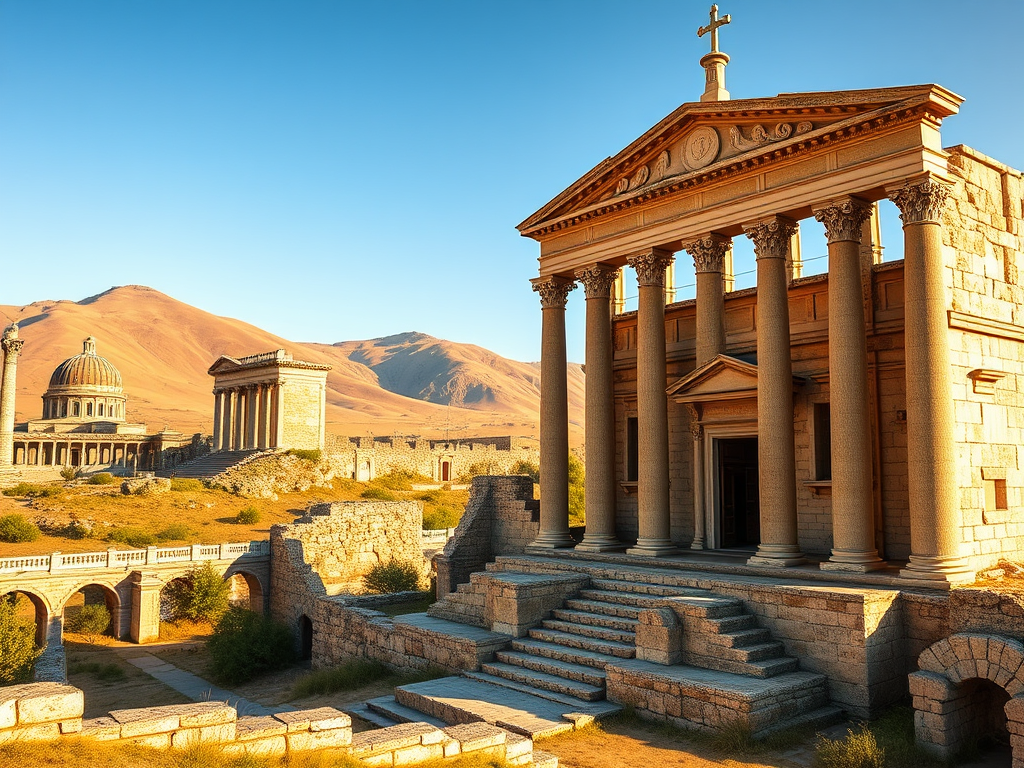
The Seven Churches – Ephesus and Smyrna.
Questions
1. What are the names of the seven churches to whom this book of Revelation is given?
Revelation 1:11 Saying, I am Alpha and Omega, the first and the last: and, What thou seest, write in a book, and send it unto the seven churches which are in Asia; unto Ephesus, and unto Smyrna, and unto Pergamos, and unto Thyatira, and unto Sardis, and unto Philadelphia, and unto Laodicea.
NOTE: The number seven is used repeatedly throughout the book, evidently to denote fullness and completion. So just seven churches represent the complete history.
2. What local church was named as representing the first period in this history of the entire church?
Revelation 2:1 Unto the angel of the church of Ephesus write; These things saith he that holdeth the seven stars in his right hand, who walketh in the midst of the seven golden candlesticks;
3. What was there desirable at that period of the church?
NOTE: The word “Ephesus” means “desirable.” The church in this period—in the days of apostolic labor—had enjoyed the doctrine of Christ in its purity; also the benefits and blessings of the Holy Spirit received.
4. Who bears this message to the church of Ephesus?
Revelation 2:1 Unto the angel of the church of Ephesus write; These things saith he that holdeth the seven stars in his right hand, who walketh in the midst of the seven golden candlesticks;
5. What assurance is there in the fact that He walks among the candlesticks?
Revelation 1:20 The mystery of the seven stars which thou sawest in my right hand, and the seven golden candlesticks. The seven stars are the angels of the seven churches: and the seven candlesticks which thou sawest are the seven churches.
Matthew 28:20 Teaching them to observe all things whatsoever I have commanded you: and, lo, I am with you alway, even unto the end of the world. Amen.
6. For what is this church commended?
Revelation 2:2-3 I know thy works, and thy labour, and thy patience, and how thou canst not bear them which are evil: and thou hast tried them which say they are apostles, and are not, and hast found them liars: 3 And hast borne, and hast patience, and for my name's sake hast laboured, and hast not fainted.
7. What reproof is given?
Revelation 2:4 Nevertheless I have somewhat against thee, because thou hast left thy first love.
NOTE: The first love, the warmth of affection experienced when the Saviour was first received and the hope of the message first dawned upon the mind, had faded out somewhat in process of years, under cares and trials. “Lord, is it I?
8. What exhortation and warning were given?
Revelation 2:5 Remember therefore from whence thou art fallen, and repent, and do the first works; or else I will come unto thee quickly, and will remove thy candlestick out of his place, except thou repent.
9. Suggest some examples of “first works.”
John 1:43-46 The day following Jesus would go forth into Galilee, and findeth Philip, and saith unto him, Follow me. 44 Now Philip was of Bethsaida, the city of Andrew and Peter. 45 Philip findeth Nathanael, and saith unto him, We have found him, of whom Moses in the law, and the prophets, did write, Jesus of Nazareth, the son of Joseph. 46 And Nathanael said unto him, Can there any good thing come out of Nazareth? Philip saith unto him, Come and see.
Luke 8:38-40 Now the man out of whom the devils were departed besought him that he might be with him: but Jesus sent him away, saying, 39 Return to thine own house, and shew how great things God hath done unto thee. And he went his way, and published throughout the whole city how great things Jesus had done unto him. 40 And it came to pass, that, when Jesus was returned, the people gladly received him: for they were all waiting for him.
2 Peter 1:5-9 And beside this, giving all diligence, add to your faith virtue; and to virtue knowledge; 6 And to knowledge temperance; and to temperance patience; and to patience godliness; 7 And to godliness brotherly kindness; and to brotherly kindness charity. 8 For if these things be in you, and abound, they make you that ye shall neither be barren nor unfruitful in the knowledge of our Lord Jesus Christ. 9 But he that lacketh these things is blind, and cannot see afar off, and hath forgotten that he was purged from his old sins.
NOTE: The first love must be renewed by coming to Jesus for the forgiveness of all sin, the full surrender of the heart, and then, constrained by the love of Jesus for others, the new convert, though perhaps old professor, will have a new experience to tell, a new song to sing, even praise unto God. Then missionary work of all kinds will be not a duty alone, but a joy; yet still a duty to which the believer must sternly hold himself against all the tendency of the flesh to become careless. Just here was the failure of the early church.
10. What commendation is given concerning their attitude toward- apostasy?
Revelation 2:6 But this thou hast, that thou hatest the deeds of the Nicolaitans, which I also hate.
NOTE: The sect of Nicolaitans was one of the earliest of the parties that sprang up within the church, undermining the truth by mysticism and fanciful teaching. Under profession of a higher philosophy of God and a more spiritual understanding of the doctrines of Christ, they brought heathen notions and moral corruptions into the church.
11. What is the call, and what the promise of the Lord to the overcomer?
Revelation 2:7 He that hath an ear, let him hear what the Spirit saith unto the churches; To him that overcometh will I give to eat of the tree of life, which is in the midst of the paradise of God.
NOTE: This and other references show plainly that the Eden that once was on earth has been transplanted to heaven.
12. What may we say of the time of this first period of the church?
Answer: It covers the early church to the time when its apostolic leaders had passed away, say to the closing of the first century and the early days of the second, the natural boundary of the first, or apostolic, era of the church, though no specific year may be given.
13. What church is named for the second period of the history?
Revelation 2:8 And unto the angel of the church in Smyrna write; These things saith the first and the last, which was dead, and is alive;
NOTE: “Smyrna’ signifies ‘myrrh,’ fit appellation for the church of God while passing through the fiery furnace of persecution and proving herself a ‘sweet-smelling savor’ unto Him.” Thoughts on Revelation.
14. How is the speaker described?
Revelation 2:8 And unto the angel of the church in Smyrna write; These things saith the first and the last, which was dead, and is alive;
NOTE: “Which was dead and is alive.” This is an assurance that One who has gone down into Satan’s prison-house, conquered death, and brought the key away with Him, was qualified to bear a message of hope and comfort to the church in that age when many were to seal their testimony with their blood.
15. What comforting assurance is given?
Revelation 2:9 I know thy works, and tribulation, and poverty, (but thou art rich) and I know the blasphemy of them which say they are Jews, and are not, but are the synagogue of Satan.
16. What scenes of tribulation were they to pass through?
Revelation 2:10 Fear none of those things which thou shalt suffer: behold, the devil shall cast some of you into prison, that ye may be tried; and ye shall have tribulation ten days: be thou faithful unto death, and I will give thee a crown of life.
NOTE: In these times of pagan persecution, the issue was practically the same as we must again face—the Christian principle of religious liberty as opposed to the Roman principle of governmental regulation of religion. The Roman law was: “No man shall have for himself particular gods of his own; no man shall worship by himself any new or foreign gods, unless they are recognized by the public laws.” The prophecy speaks of “ten days.” The last and severest persecution of this period was a sustained effort to suppress Christianity, lasting ten years. Ten days. prophetic time—a day for a year—would be ten years, literal time “It was not till A. D. 311,” says Lecky, “ten years after the first measure against the Christians, that the Eastern persecution ceased. Galerius, the arch-enemy of the Christians, was struck down by a fearful disease.” He suspended his edict and besought Christians to pray for his recovery.
17. What was the cheering promise?
Revelation 2:10-11 Fear none of those things which thou shalt suffer: behold, the devil shall cast some of you into prison, that ye may be tried; and ye shall have tribulation ten days: be thou faithful unto death, and I will give thee a crown of life. 11 He that hath an ear, let him hear what the Spirit saith unto the churches; He that overcometh shall not be hurt of the second death.
18. What special period of time is covered by this second stage of church history?
Answer: From early in the second century, through the days of pagan persecution, to the time of Constantine, whose professed conversion, in A. D. 323, opened a distinctly third era in church history.
19. What picture does Inspiration set over against these descriptions of times of trial?
Revelation 7:13-17 And one of the elders answered, saying unto me, What are these which are arrayed in white robes? and whence came they? 14 And I said unto him, Sir, thou knowest. And he said to me, These are they which came out of great tribulation, and have washed their robes, and made them white in the blood of the Lamb. 15 Therefore are they before the throne of God, and serve him day and night in his temple: and he that sitteth on the throne shall dwell among them. 16 They shall hunger no more, neither thirst any more; neither shall the sun light on them, nor any heat. 17 For the Lamb which is in the midst of the throne shall feed them, and shall lead them unto living fountains of waters: and God shall wipe away all tears from their eyes.
 The Bible Students' Library